



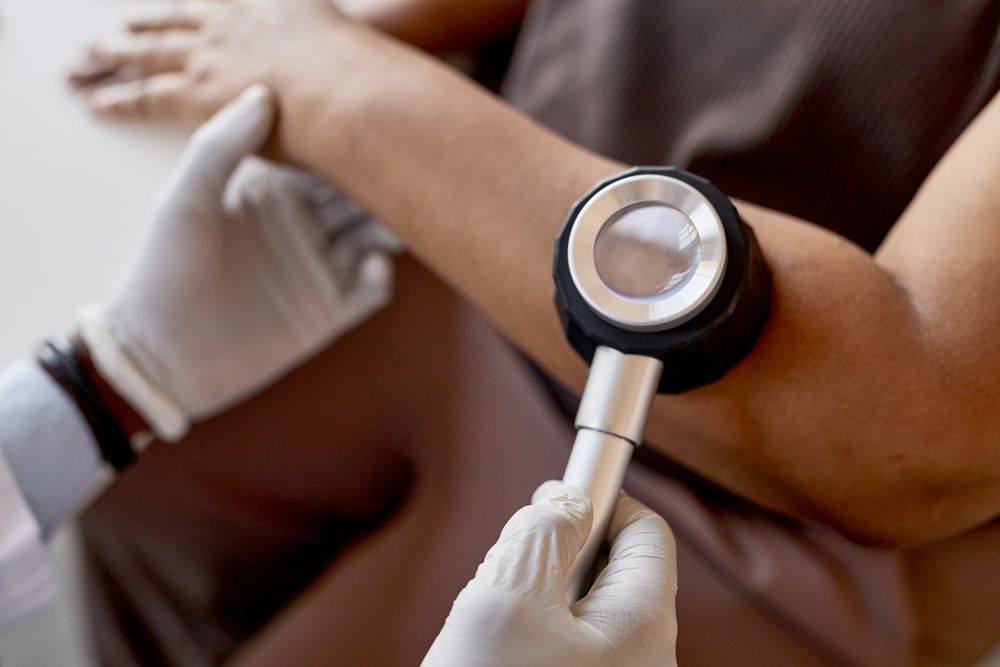
By October, summer’s weekends on the Potomac and afternoons at outdoor events are behind you, but your skin still carries the record. Many people first notice a new spot in fall, a mole that looks a little different or a patch of discoloration they can’t place. Most of these marks are harmless. A few deserve a trained eye. This guide explains how to tell common post-summer brown spots from the ones worth having checked, and what a professional mole evaluation involves.
Brown Spots vs. Moles: What Your Skin May Be Telling You
Not every dark mark that appears after summer is a mole, and not every mole is cause for alarm. Understanding the general categories can help you approach your skin evaluation with clarity.
Common Post-Summer Brown Spots
Solar lentigines, often called sun spots or age spots (see our brown spots page), are flat, evenly pigmented marks that tend to appear on sun-exposed areas such as the face, shoulders, and forearms. They typically develop gradually and remain stable in color and shape. Seborrheic keratoses are another frequent finding: waxy, stuck-on-looking growths that range from tan to dark brown and are generally benign. These are benign skin growths that a dermatologist can assess and, if desired, treat.
Post-inflammatory hyperpigmentation from a summer sunburn can also leave behind flat discoloration that patients sometimes mistake for new moles. Our team frequently evaluates pigmentation concerns ranging from subtle sun damage to more complex patterns, and distinguishing between these presentations is a routine part of a thorough skin exam.
When a Spot May Warrant Closer Evaluation
The ABCDE criteria offer a well-recognized starting framework: Asymmetry, Border irregularity, Color variation, Diameter larger than a pencil eraser, and Evolution or change over time. An itchy spot, one that bleeds without trauma, or one that appears to be growing warrants prompt professional attention. That said, these criteria are guides, not a diagnostic checklist you should use alone.
Some concerning lesions appear deceptively ordinary, while some alarming-looking spots are entirely benign. A board-certified dermatologist brings clinical training and dermoscopy tools that go well beyond what a patient can observe at home. If you have any doubt, have a professional look at the spot.
Inside a Full-Body Skin Exam
Many patients aren’t sure what a professional skin exam involves, which can make the process feel more intimidating than it needs to be. At Arlington Dermatology, a mole check is a thorough, structured evaluation that gives you a complete picture of your skin health.
Full-Body Skin Examination
A comprehensive skin exam covers all skin surfaces, including places patients often overlook such as the scalp, between the toes, and the back. Your provider may use magnification (dermoscopy) to look more closely at any spot that stands out. If a lesion needs a biopsy, your provider will explain the next steps and how results are shared.
Skin Cancer Screening and Next Steps
Skin cancer screening is a core part of medical dermatology, and it is typically billed to insurance. Patients with a personal or family history of skin cancer, significant cumulative sun exposure, or a history of tanning bed use are generally advised to be checked more often, and our team will recommend a schedule that fits your history. Learn more about our approach to skin cancer evaluation and treatment.
When the Spot Is Cosmetic, Not Concerning
A post-summer skin check is also a good time to discuss sun damage that isn’t a medical concern but still affects how your skin looks.
Treating Post-Summer Pigmentation and Texture
If your provider identifies solar lentigines, surface texture changes, or uneven tone that you would like to address, Arlington Dermatology offers several treatment pathways under one roof. Fraxel laser, one of our featured treatments, may help reduce the appearance of sun spots, fine lines, and irregular texture with a series of sessions.
For patients exploring options for skin aging and facial concerns, our team can outline realistic expectations and recommend an approach suited to your skin type and goals.
Who Will Examine Your Skin
Arlington Dermatology is led by board-certified dermatologists Dr. Ellinor Coyne and Dr. Matthew Livingood, who see patients for everything from routine mole checks to complex medical dermatology. They are joined by physician assistants Katherine Mahdavi, PA-C, and Ryan Wood, PA-C, and licensed aesthetician Abbey Bautista, giving patients across Arlington, McLean, Alexandria, and the DC area more scheduling flexibility and medical and cosmetic care in one office. You can meet the full team before your visit.
What Patients Ask Before a Skin Check
How often should I schedule a mole check in Arlington, VA?
Most dermatologists recommend a full-body skin exam at least once per year for adults. If you have a personal or family history of skin cancer, significant prior sun exposure, or many moles, your provider may suggest more frequent intervals. The post-summer period is a practical time to schedule because UV exposure from the warmer months is fresh and any new changes are easier to identify.
Can I bring up cosmetic concerns at the same appointment as my skin cancer screening?
Yes. Because Arlington Dermatology offers medical and cosmetic dermatology under one roof, patients can ask about sun damage, pigmentation, or skin rejuvenation during the same visit as their skin exam. A cosmetic consultation can be added to a medical exam for an additional fee. Mention everything you would like to address when you book so we can plan enough time.
What is the difference between a mole and a seborrheic keratosis?
Moles, or melanocytic nevi, arise from pigment-producing cells called melanocytes and may be present from birth or develop over time with sun exposure. Seborrheic keratoses are non-melanocytic growths that often appear waxy or “stuck on” and are among the most common benign skin growths seen in adults.
Both can look similar to an untrained eye. A board-certified dermatologist can distinguish between them clinically and with dermoscopy, which is why professional evaluation is recommended over self-assessment alone.
Will my insurance cover a skin cancer screening or mole check?
Skin exams and mole evaluations are medical dermatology services that are typically billed to insurance. Coverage varies by plan, so confirm your benefits before your appointment, and our team can help with questions when you schedule.
Is there anything I should do to prepare for my mole check appointment?
Arrive with clean, bare skin if possible; remove nail polish so the provider can check your nail beds, and avoid heavy lotions or self-tanner beforehand. Wear hair loose so the scalp can be examined. Bring a list of any spots you have noticed changing, itching, or growing, and note how long those changes have been occurring. If you have had prior biopsies elsewhere, bringing those pathology reports helps your dermatologist establish a complete baseline for your skin history.
Put a Skin Check on Your Fall Calendar
If a spot has changed, or you simply haven’t had a full-body exam this year, fall is a good time to book one. Contact our Arlington office by scheduling a consultation online.